Home |Products |Downloads |Order |Support |Applications |Forum |Testimonials |Company |Contact Us


Applications

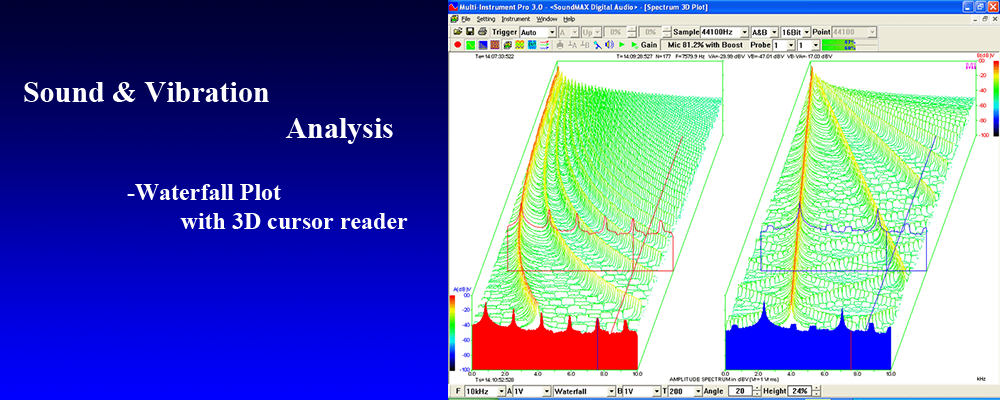
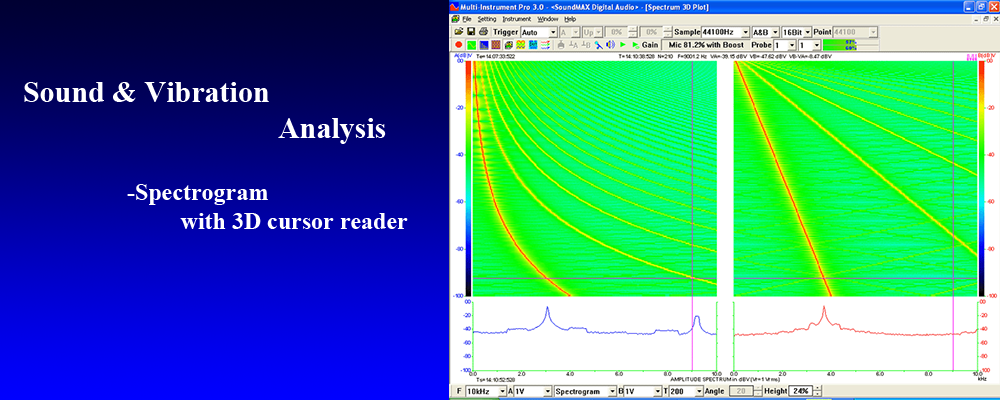
With Multi-Instrument or Pocket Multi-Instrument software, without any additional ADC and DAC hardware, you can turn your PC or Pocket PC into a multi-function test and measurement instrument by using its built-in sound card or sound chip as the ADC and DAC device.  The sampling rate can be up to 192 kHz and the sampling bit resolution can be up to 24 bits.  The software have a wealth of features normally only found in much more expensive instruments.  Generally, the sound card or sound chip supplied with a PC or Pocket PC is sufficient to allow measurement in the audio frequency range.  Perfect measurement quality can be archived by using a professional grade sound card.  Together with the VIRTINS Sound Card Oscilloscope Probe P601, which has three attenuation positions, the instrument is able to measure a signal with a magnitude from as low as 1 µV to 24 V. 


You can also integrate transducers, ADC and DAC hardware (e.g. sound cards, NI DAQmx cards, VT DSO-2810F, etc.), computer and Multi-Instrument software together to form a professional test and measurement system. 


Multi-Instrument and Pocket Multi-Instrument have been widely used in many areas. The following are some application examples or notes categorized by application areas. We will be adding contents gradually in each category. If you have any comments on any topic, you can put it under the discussion forum.


Demo Tests


Applications in Education and Training

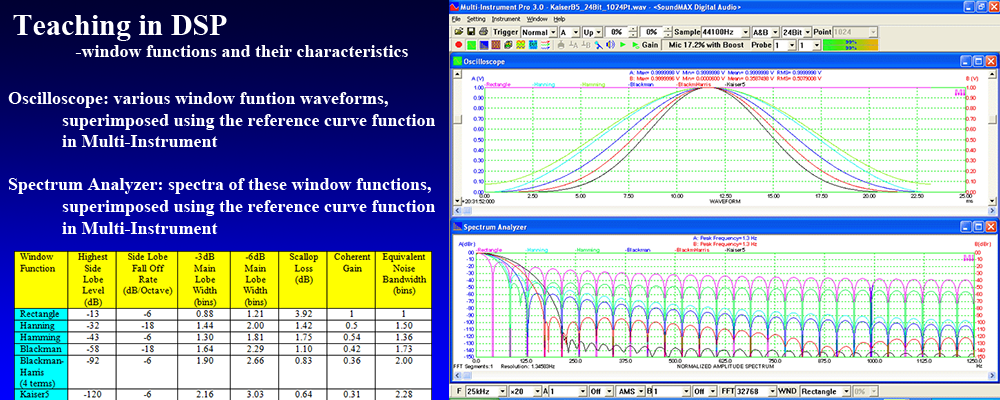
Multi-Instrument can be used as an assistant tool in teaching wave-related or sound-related science and physics in primary schools, middle schools and high schools, electronic-signal-related topics in vocational schools, and DSP subject in universities. It can also be used in laboratories in place of those much more expensive instruments such as standalone digital storage oscilloscope, spectrum analyzer, signal generator and frequency counter, etc. You can also use Pocket Multi-Instrument in teaching if your class room is equipped with a projector.


A laptop or Pocket PC without any additional accessories and wires is enough for demonstration in a class if you do not intend to measure the actual electronic signals.  You can generate the desired signals and see their waveforms and spectra within the software. This can be done by establishing a loopback at software level via selecting the "iA=oA, iB=oB" option in the Signal Generator, or by establishing a loopback at the sound mixer level via choosing "Wave Out Mix" or the like as the input source in the Recording Control under Window Control Panel. 


Applications in Audio Engineering

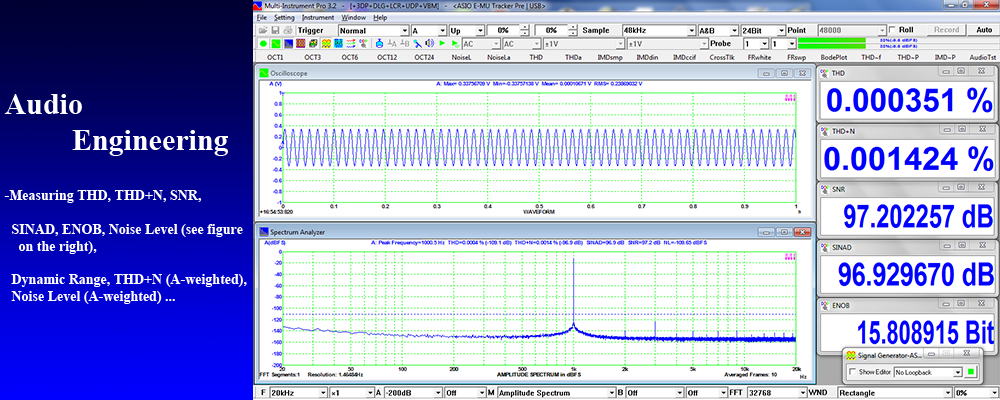
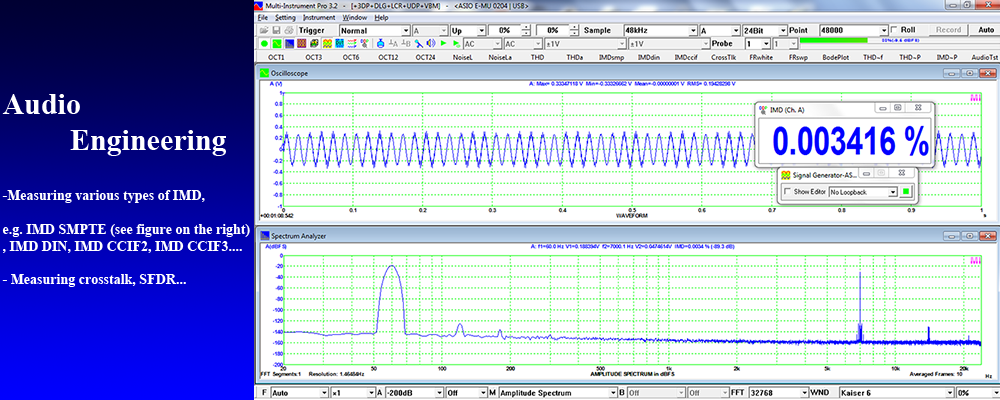
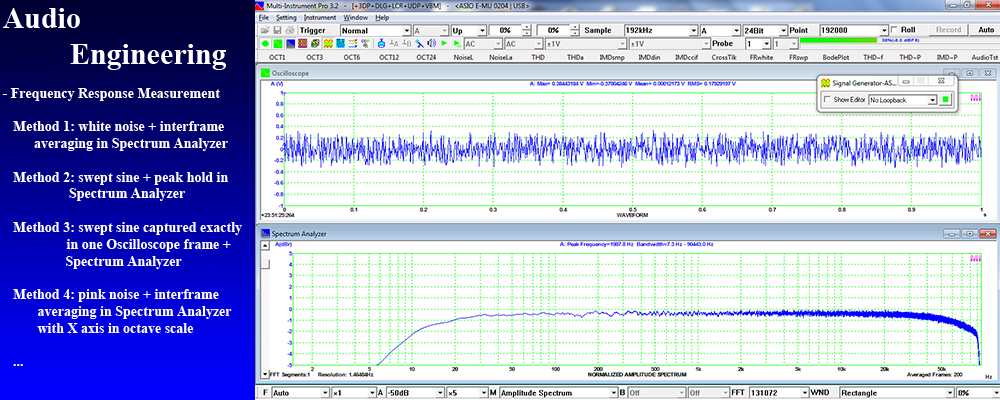
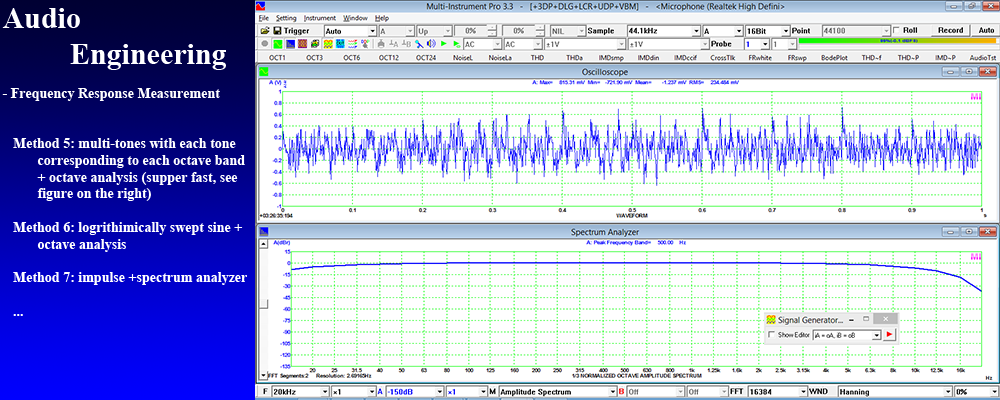
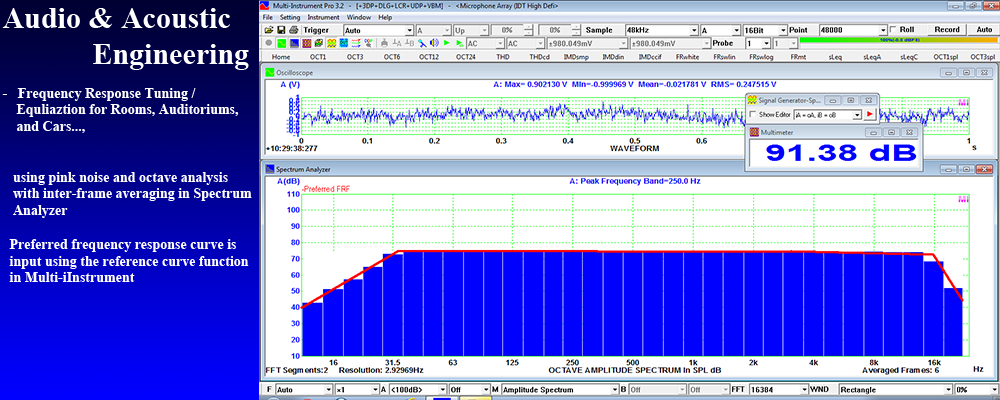
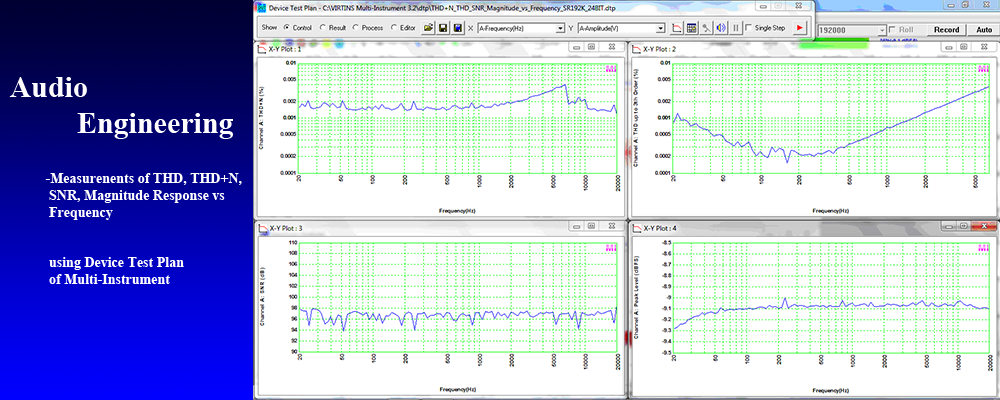
Multi-Instrument and Pocket Multi-Instrument can be used to measure audio parameters of an audio system, tune an audio system, measure sound pressure level, analyze noises, etc.  


Applications in Scientific Research

Scientific research usually requires high flexibility in choosing measuring parameters and capability to view a single data point out of  thousands of data points acquired.  Multi-Instrument is well designed to carter for these needs. 

Application Note 1: Extremely Low Frequency Radio Emission from Flying Insects


In 2005, Walton C, Koemel used the tune radio frequency (TRF) receiver (20~18,000Hz) developed by Walton C. Koemel and Philip S. Callahan ("Relationship of Extremely Low Frequency Radio Emission from Flying Insects to Semiochemical Communication", Annals of The Entomological Society of America, Vol. 87, No. 5, pp. 491-497, 1994) together with Multi-Instrument to investigate the extremely low frequency radio emission from flying insects such as European honey bee, African honey bee, Mosquito, etc. 


The screenshot shows the radio emission signal received from an European honey bee.  When you see a peak that has a smaller peak on the side, the taller peak is produced by the wing closer to the TRF radio receiver antenna. The smaller peak is produced by the wing farther away.  In this case, the wings are almost in phase with each other.  When you see a series of tall peaks with short peaks in between, the wings are almost 180 degrees out of phase with each other. You can also see how the wing-beat frequency changes from wing-beat to wing-beat.  


(Courtesy of Walton C, Koemel, Texas, USA)


Applications in Industrial Instrumentation

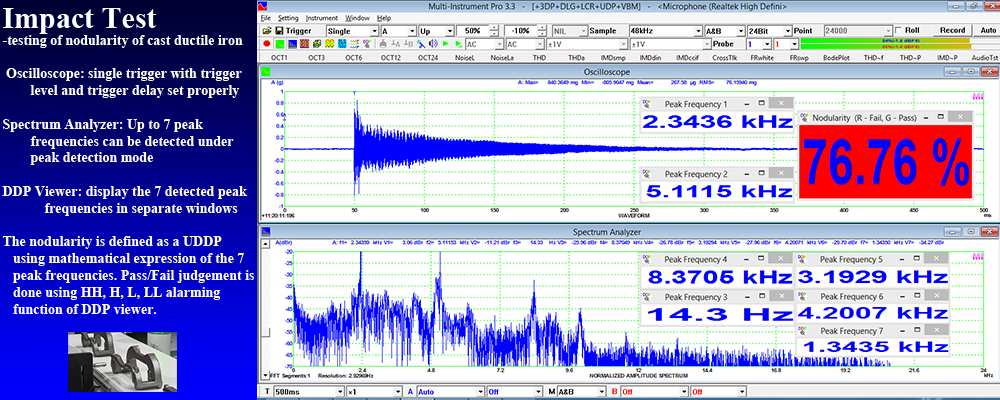
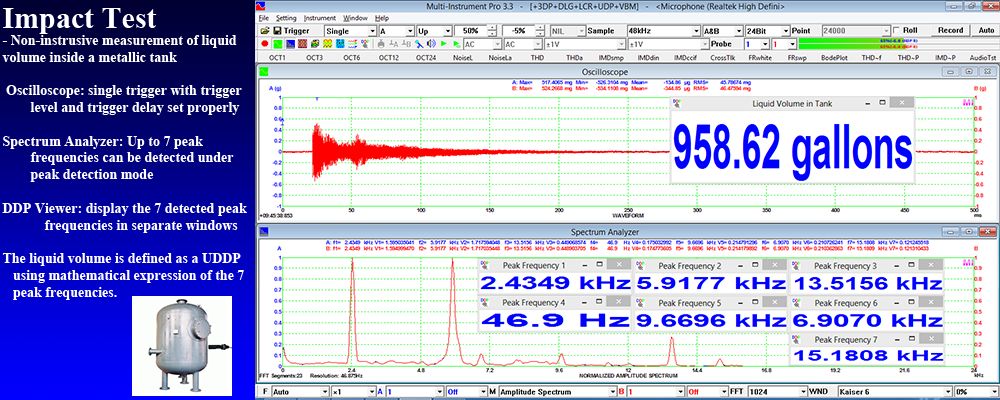
Multi-Instrument and Pocket Multi-Instrument are useful tools in vibration analysis, earthquake wave measurement, rock density measurement, tank liquid volume measurement etc.  It is very handy especially when you are at site. See an application by Turbomagnetics Research Associates, Santa Cruz, California, USA.


Applications in Electronic & Electrical Test and Measurement

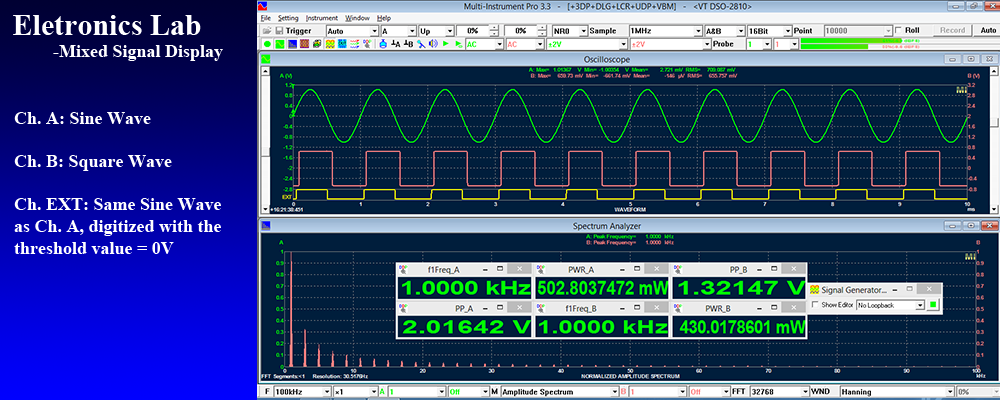
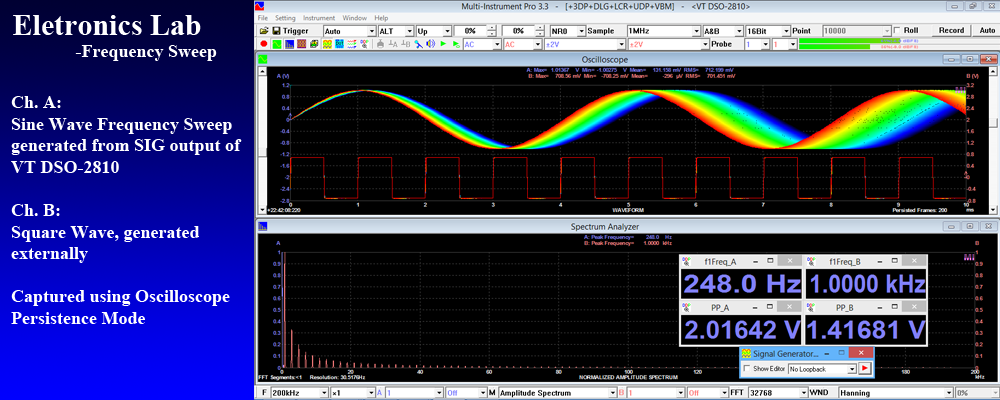
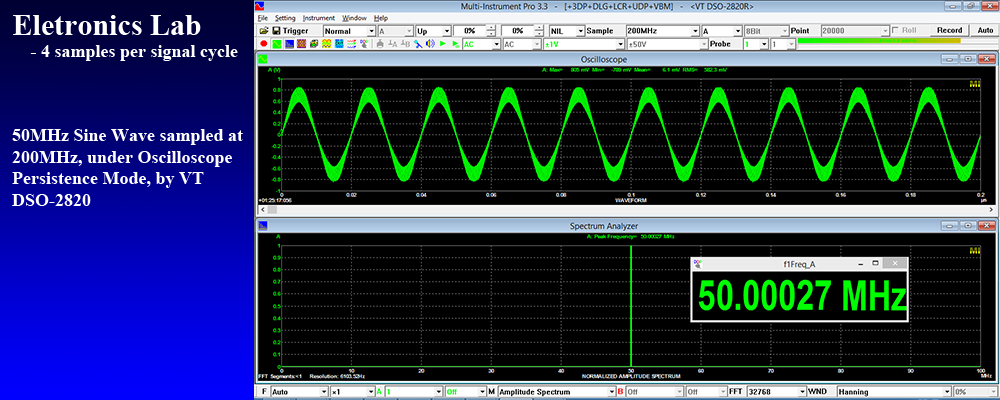
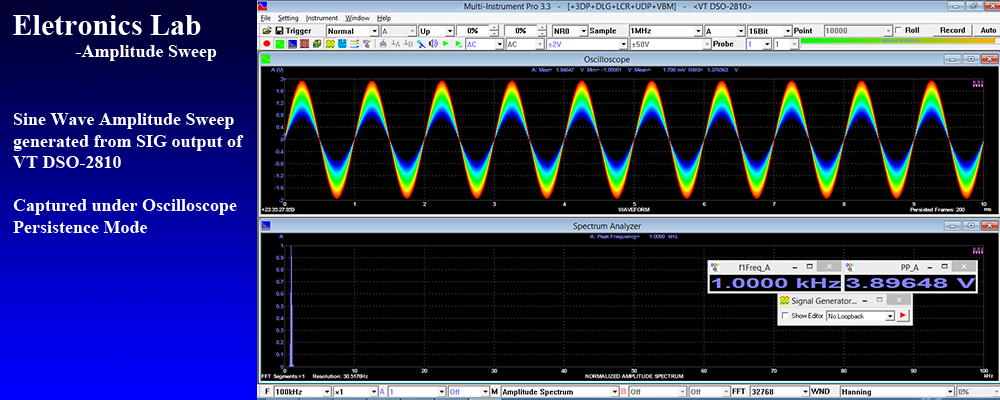
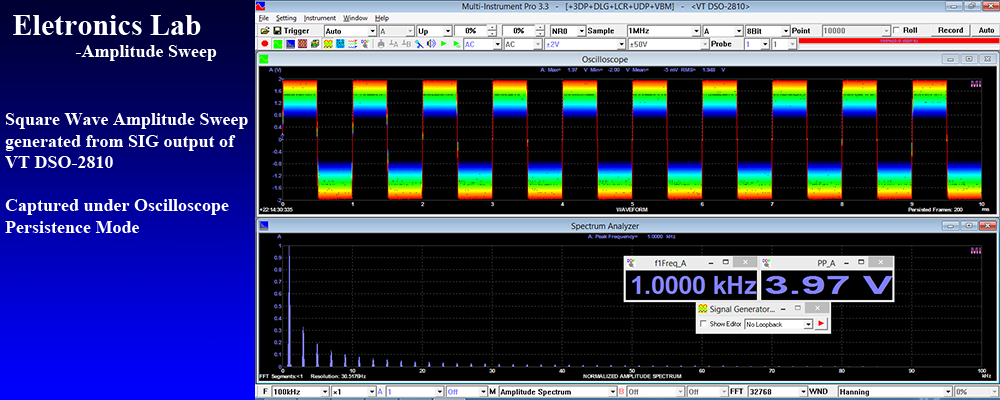
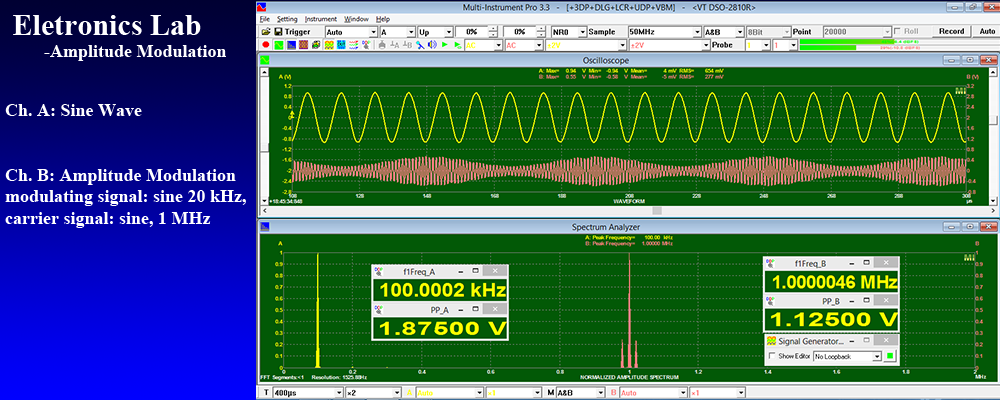
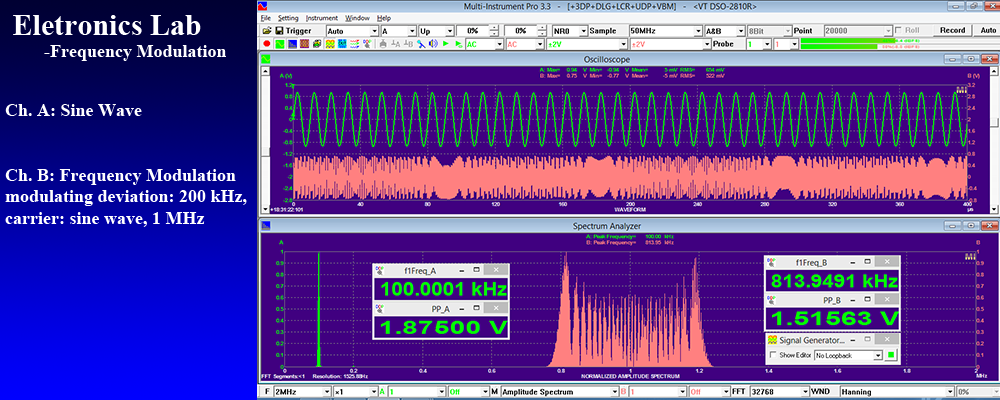
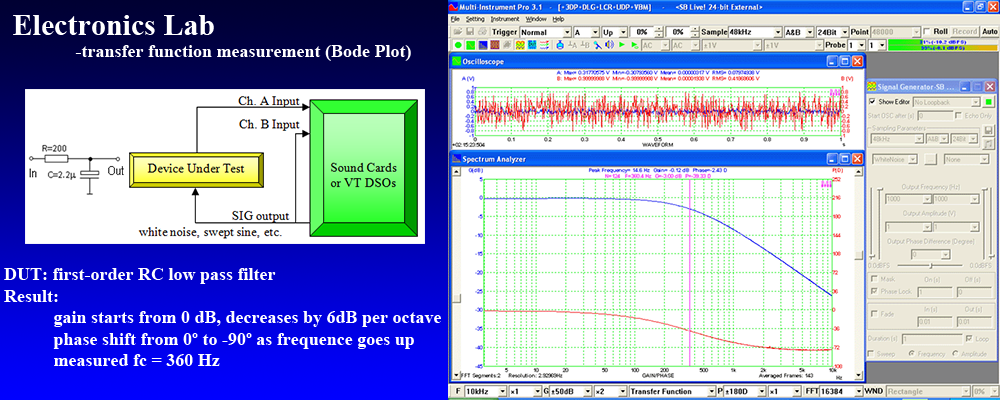
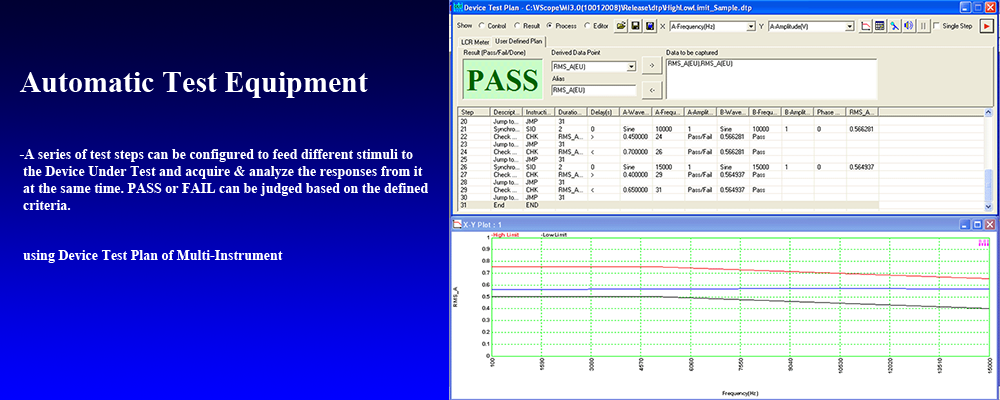
Multi-Instrument can replace a bundle of traditional standalone oscilloscope, spectrum analyzer, signal generator, multimeter, network analyzer, etc. in an electronics lab. With the capability to run multiple instruments simultaneously, it can be use to measure the characteristics of a device under test (DUT), such as frequency response and impedance.

Application Note 1: Sherlock In The XP Age 

By Malcolm C. Mallette, WA9BVS, published in CQ VHF winter 2006 issue. (see introduction in the magazine)


In this article, Malcolm C. Mallette presented a new "Sherlock" transmitter fingerprint system which used VIRTINS Sound Card Oscilloscope together with a FM receiver to identify transmitters by their turn-on and turn-off fingerprint. 


When the microphone button of a transmitter is pressed, during the first two-tenths of a second, the transmitter moves in a pattern around the operating frequency, as the phase locked loop locks up. That is what is meant by the turn-on characteristic (or fingerprint) of a transmitter. Similar movements in frequency when the transmitter is turned off are referred to as the turn-off characteristic (or fingerprint).  To capture a transmitter’s turn-on and turn-off fingerprints, the software must capture the frequency movements of the transmitter in the two-tenths of a second when it turns on or off

He demonstrated that with VIRTINS Sound Card Oscilloscope connected to the output of the detector in a FM receiver, he was able to capture and save the transient turn-on and turn-off fingerprints of  a transmitter. The screenshot shows 10 seconds of reception, with typical noise for the first 3 seconds, followed by a few seconds of a received transmission, then noise again.

(Courtesy of CQ Communications, Inc)


Applications in Musical Instrument Inspection

You can use Multi-Instrument and Pocket Multi-Instrument to tune your musical instrument with high accuracy. Be sure to set the scan time, FFT size and sampling frequency properly to achieve high frequency resolution.  We recommend a scan time of 500 ms, a FFT size of of 32768 and a sampling frequency of 44100 Hz for musical instrument calibration. 


Applications in Biomedical Instrumentation

Biomedical signals normally have frequencies within or near audio frequency range, e.g. electrocardiogram (ECG/EKG), lung and heart sound, Electroencephalogram (EEG), etc. Multi-Instrument and Pocket Multi-Instrument can be used to capture and display these biomedical signals to the doctor at real time for diagnosis. The data can be saved for later reference.  


Home |Products |Downloads |Order |Support |Applications |Forum |Testimonials |Company |Contact Us

Companylogo.GIF

Copyright © 2004-2010 Virtins Technology. All rights reserved.